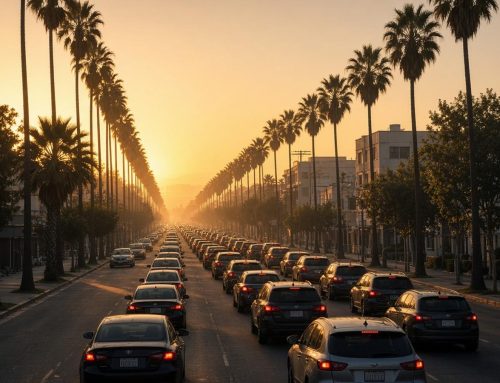
For people who live and work in the foothills, the 134 is not just a freeway. It is the daily route between Burbank studios, Glendale offices, Eagle Rock, and Pasadena. It carries commuters, delivery vans, and drivers merging from the 5, the 2, and the 210, often at speeds that leave little margin.
When a crash happens there, the steps you take in the first days matter. This guide covers what is different about a freeway collision and how to protect a claim.
Where does the 134 run, and why does it matter?
State Route 134, the Ventura Freeway, runs east-west along the north side of the Los Angeles basin. In our area it passes Burbank, Glendale, and Eagle Rock and connects to Pasadena near the 210 and 710. Along the way it meets the I-5 and the SR-2, among other interchanges.
Interchanges and short merge sections are where many freeway collisions happen: drivers cutting across lanes for an exit, sudden braking when traffic stacks up, and rear-end crashes when the flow stops. We do not publish crash counts here that we cannot verify, but anyone who drives the 134 at rush hour knows the pattern.
Who responds to a crash on the 134?
On state freeways, the California Highway Patrol (CHP) generally investigates collisions, not the Glendale, Burbank, or Pasadena police departments. That matters for one practical reason: your report will come from CHP, and you request it from the CHP area office that handled the crash. CHP explains the process on its crash report page.
If a crash happens on a surface street after you exit, such as Brand Boulevard or Glenoaks, the local police department usually handles it instead. Write down exactly where the collision happened.
What should I do right after a freeway crash?
Get safe first. If the cars can move and no one is seriously hurt, move to the shoulder or off the freeway if it is safe to do so. Standing in live freeway lanes is dangerous. Stay in your car with your seatbelt on if you cannot get clear.
Call 911. Report injuries and your location. Use the nearest exit, overpass, or call box marker to describe where you are.
Stop and exchange information. Vehicle Code section 20001 requires drivers involved in a collision that injures someone to stop at the scene. Get names, license, plate, insurance, and the vehicle owner’s information if different.
Photograph quickly and safely. Vehicle damage, plates, debris, skid marks, lane positions, and your injuries. Do not step into traffic for a photo.
Get witnesses. Freeway witnesses often drive away. If someone stops, get a name and phone number.
Report to the DMV. Under Vehicle Code section 16000, a driver in a collision involving injury, death, or property damage above the statutory threshold must file an SR-1 with the DMV within 10 days. A CHP report does not take its place. See the DMV’s SR-1 page.
What evidence is unique to freeway crashes?
Freeway collisions often involve chain reactions and lane changes where everyone says the other driver moved first. Independent evidence settles those disputes:
- Dashcam footage, from your car, the other car, or a witness. Ask now.
- Vehicle data. Many modern vehicles record speed, braking, and other data around a crash. Preserve the car before it is repaired or salvaged.
- Commercial vehicle records. If a delivery van, bus, or truck was involved, the company may have telematics, video, and driver logs. Those need a prompt preservation request.
- Phone records may matter if distraction is suspected, though obtaining them usually requires a legal process.
- Tow and storage records show where the vehicles went, which matters for inspections.
Evidence like this can disappear quickly. A preservation letter sent early can make a real difference.
Who pays after a 134 crash?
California is a fault-based state. The at-fault driver’s liability insurance is usually the main source of payment. In a multi-car crash, more than one driver and insurer may share responsibility. If the at-fault driver has no insurance or too little, your own uninsured/underinsured motorist coverage may apply, depending on your policy. If a work vehicle was involved, the employer may also be responsible.
California follows comparative fault. If the insurer argues you share some blame, for example for a lane change, your recovery may be reduced by your percentage of fault, but it is not automatically barred.
What do insurers say after freeway crashes?
Expect arguments like:
- “Sudden stop.” The rear driver claims the lead driver braked for no reason. Traffic conditions and video matter.
- “Phantom vehicle.” Both drivers blame a car that left. Uninsured motorist coverage may apply, and policies have specific requirements.
- “Low-speed impact, no injury.” Damage to the bumper does not measure what happened to your neck or head.
Be careful about recorded statements to the other driver’s insurer before you understand your injuries.
How long do I have to file a claim?
Most personal-injury claims in California have a two-year limitation period under Code of Civil Procedure section 335.1. Claims involving a public entity, such as a dangerous freeway condition, require an earlier government claim. Do not wait until the deadline is close.
Talk With Advo Law
Our offices in Glendale and La Cañada Flintridge sit close to the 134 and 210, and we handle freeway crash claims throughout Los Angeles County and California. See our car accident, Glendale, Burbank, and Pasadena pages, or reach us through our contact page.
Contact Advo Law, APC
Phone: (800) 808-4613
Contact page
Glendale: 111 E. Broadway, Suite 210, Glendale, CA 91205
La Cañada Flintridge: 1433 Foothill Blvd., Suite 207, La Cañada Flintridge, CA 91011
Contingency fee representation. Statewide California.
This article is general information about California law, not legal advice about your specific situation. Reading it does not create an attorney-client relationship. Attorney advertising.